

GUNNER TRUGGY 6S 1/8 Radio Control Electric Car
GUNNER TRUGGY 6S 1/8 Radio Control Electric Car
GUNNER Truggy 6S 1/8
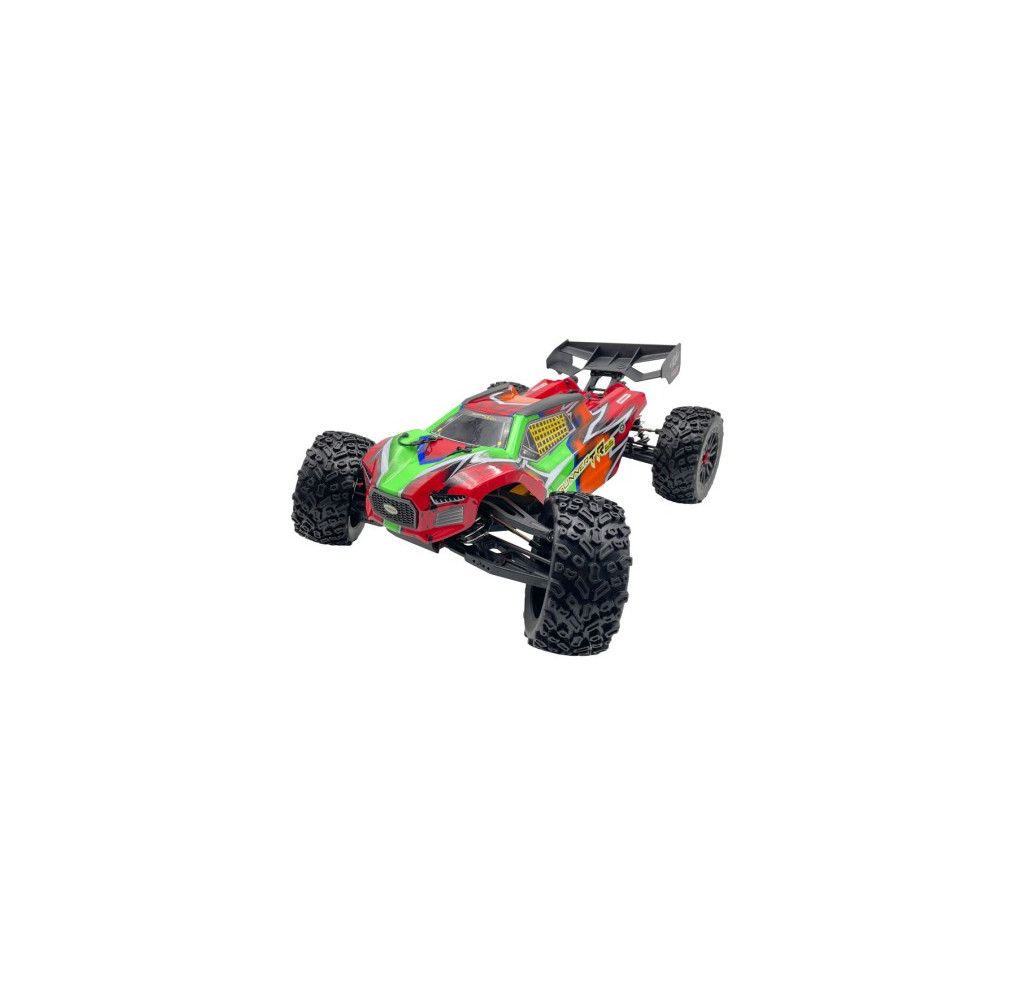
The all-new GUNNER Truggy 6S is a high-performance, ultra-tough 1/8 scale RC vehicle for you to push the extremes.
You can use it in a friendly way as your electric GUNNER Buggy or use it to practice the Bash and push your limits.
RC Bashing consists of driving your radio-controlled car at full speed by not following any rules, making the highest jumps, even rolling over.
The race involves a professional track or an area provided for this purpose, rules, regulations and intentions.
You don't drive an RC car just for fun, but rather to win.
To be as efficient, the GUNNER Truggy 6S has been completely modified from the Buggy of the same name.
It is a brand new chassis with top-of-the-range HOBBYWING brand equipment that powers the car, namely a 2000KV Brushless motor, a 150A Brushless electronic variator.
For you to have more or less power depending on your piloting and your wishes, this equipment must be supplemented by a maximum power supply of 6 elements (6S), i.e. a choice of:
2 x 2S LiPo batteries 2 x 3S LiPo batteries 1 x 4S LiPo battery 1 x 6S LiPo battery
In order to be able to pass so much power without hindrance, XT-90 sockets are fitted as standard to the car's electronics.
The charger is also to be purchased separately depending on the batteries chosen.
This brushless 1/8 Truggy features a 4WD system with three reinforced differentials that precisely distribute the strong power to each of the four wheels.
A central reinforcement bar in red anodized aluminum reinforces the resistance of the chassis to all the tests that you will make it endure.
This new chassis is equipped with all high quality ball bearings.
The new front spindles which are equipped with a ball joint system, the Big Bore hydraulic shock absorbers, the front and rear shock absorber supports as well as many parts distributed on the chassis are in red anodized aluminum.
The shock absorbers have sealing bellows to protect them from dust and give them maximum and long-lasting use without seizing. They have 3 different anchor holes on the shock absorber supports, innovative upper protections.
The geometry of the trains is fully adjustable and front and rear anti-roll bars are present on the chassis.
The new anodized aluminum motor support has been designed to allow you to disassemble and change the motor pinion in record time as if you were in the pits of an R/C competition.
The large, heavy-duty front suspension arms have enough flexibility to absorb shocks.
The receiver compartment is dust and splash proof.
The crowns and motor pinion are made of hardened steel.
A new "BAT" spoiler and a sublime painted and decorated aerodynamic body with roof protections will look great on the tracks you will take to impress your friends.
The high grip rubber tires will ensure maximum traction of the vehicle on all types of surfaces like, asphalt, grass, dirt.
The MHD3S 3-way radio control with integrated LiPo battery and the MHDPRO 15 kg steering servo are already installed.
Other Features: 49 Tooth Drive Sprocket with 14 Tooth Heavy Duty Hardened Steel Motor Pinion Drive System with Hardened Steel Universal Joints 17mm Red Anodized Aluminum Wheel Hexes Anodized Aluminum Akerman Bar Quick and easy driveline access for adjustment or maintenance with a new, thoughtful engine mount High-strength adjustable tie-rods Front and rear anti-roll bar system 5mm red anodized aluminum F/R shock mounts Reinforced nylon composite chassis side guards for the body Front and rear bumpers in very resistant composite Front and rear chassis reinforcements in very resistant composite “BAT” type spoiler and its reinforced support with high dynamic force Superior quality BTR screws
With the GUNNER Truggy 6S you will be able to evolve on the most uneven terrain, beyond the limits. Harness the power of 6S brushless and power through any obstacle with balance and control that only a top quality racing vehicle can have.
Preparando-se para ligar o veículo:
Este veículo é compatível com baterias LI-PO até 6S equipadas com um plugue XT-90.
O controlador 150A Brushless permite conectar 2 baterias Li-Po 2S ou 3S simultaneamente.
Sempre conecte 2 baterias idênticas.
Se você quiser usar uma única bateria 3S a 6S, conecte o loop incluído ao soquete XT90 não utilizado do controlador brushless.
Starting the vehicle:
1: Charge the MHD3S remote control battery using the included USB cable by connecting to a minimum 1A USB power supply.
2: Lift the cover of the MHD3S remote control and put the POWER switch in the ON position, the LED lights up
3: Install your charged battery(ies) on the chassis of the vehicle, secure it well using the 2 Velcro straps, ensure that the cables do not
not touch moving parts, connect the battery(ies) to the XT-90 sockets of the car's brushless controller, then put it
under pressure . The controller will beep and its fan will turn on.
Check that the connection with the car is established by swiveling the steering wheel of the remote control, the wheels must turn in the same
General Notice of Precautions and Use of LI-PO batteries.
NOTE: This manual contains important information on the proper use of Lithium Polymer batteries.
Please read completely before using the batteries for the first time. Please ensure that you have fully understood the instructions and
instructions below before using or charging Lithium Polymer batteries. Otherwise, you risk
cause a fire, to be the victim of a serious accident with very serious physical injuries or to subject your home and your
close to major damage. Use of this battery is not suitable for children under 14 years of age. It should always happen
under the supervision or by an adult. Scienti c-MHD assumes no responsibility for the outcome of any
misuse of the product or failure to follow these guidelines and instructions. Purchaser and end user assume all
risks associated with this product. Lithium Polymer batteries require special care and attention for charging and use.
A LiPo battery can store and restore a large amount of energy for the use of a scale model but can
also be very dangerous if misused.
Charge
1.1 First load
Do not use new batteries without having fully charged them with a balance charger speci c for LiPo batteries.
Check that your battery has not suffered any damage, that it is not swollen or that certain elements have not been the victim of perforations. If it was
If so, do not charge your battery, it has become unusable at risk of serious danger.
If you notice any change in the general appearance of your battery DO NOT CHARGE IT.
1.2 Charger
Only use a specific balancing charger for LiPo batteries. Other types of chargers should not be used to charge these batteries.
1.3 Charging current
Never recharge the batteries with an intensity higher than that recommended. Non-recommended intensities can lead to losses of
performance, overloads and even leaks. Always check the settings of your LiPo charger and make sure that the charging program
charge is suitable for your battery. Incorrect settings can damage the battery and cause the battery cells to catch fire.
1.4 Charging voltage
Allow lithium batteries to cool completely before recharging. Do not exceed a charging voltage greater than 4.20V per cell. For the
packs select the corresponding voltage or recharge each element separately. Serial charging is not recommended. Check that the
number of cells in your pack corresponds to the number of cells detected by your charger. Be sure to place your batteries on a support that is not
flammable during charging and maintain a radius of at least 3m free of any object around the battery pack. We recommend using
a protection and safety bag specially designed for LiPo packs. Never charge a LiPo battery on a flammable surface such as a table
in wood or in a car.
1.5 Charging temperature
Batteries should be charged at ambient temperatures between 15°C and 35°C, otherwise the charging performance
and discharge could be reduced.
1.6 The inversion of polarities is to be avoided
Check that the positive (+) and negative (-) poles of the charger and the battery are correctly connected to each other, never reverse them. An inversion would deteriorate the capacities of the battery, it would also lead to potentially dangerous consequences, overheating and leaks and could even
cause the batteries to catch fire.
1.7 Elimination of abnormal phenomena during charging
If any abnormal phenomena appear during charging, immediately stop the charging process and consult the professionals
authorized to dispose of the battery. Never leave your battery on charge unattended. Always monitor the charge of your batteries, and
in the event of overheating immediately unplug the charger. In the event of a fire, be sure to smother the flames with sand that you will have kept
proximity: never use water to put out the fire.
Use
2.1 Balancing check
Check the battery voltage before use. The voltage di erence between the elements should not be too large, if it is less than 30mV it
no need to recharge. If it is between 30mV and 100mV, it is recommended to recharge. If it exceeds 100mV, it is absolutely necessary to recharge
before use. Excessive voltage di erences between the elements induce excessive discharges which will lead to
overheating, performance deterioration and reduced service life. It is advisable to use a balance charger.
2.2 Discharge current
Never discharge the batteries with continuous discharge currents higher than those indicated in the characteristics of the batteries, the performances
and the service life would be reduced with the risk of overheating, swelling, rupture and internal short-circuiting.
2.3 Discharge temperature
If the surface temperature is above 65°C during use, the battery should be allowed to stand to cool down to temperature.
ambient. Higher temperatures can cause swelling and reduced performance.
Reminder: in the event of inflation, the battery is unusable.
2.4 End of use voltage
Check that the cut-off voltage is not lower than 3.0V per element, it is even recommended not to go below 3.3V, otherwise
performance would be reduced due to over-discharge.
Storage and transport
3.1 Transportation
Avoid strong vibrations, shocks and high temperatures during transport and keep them under surveillance. All batteries must be
packed in protective material for transport.
3.2 Prolonged storage
If the batteries must be stored for a prolonged period, check that they are stored at a voltage of 3.7V per cell, i.e. at approximately 80%
of the maximum load. Charge and discharge them regularly (about 1-3 times every 3 months).
3.3 Storage environment
Store the batteries in a place with low humidity free of any corrosive gas, at a temperature between -20°C and +40°C.
Additional Notes
4.1 Avoid dropping, shocking and short-circuiting the batteries.
4.2 Never disassemble the batteries. do not perform any transformation of your pack.
4.3 Do not throw batteries into a fire or immerse them in any liquid. Do not leave it near liquid.
4.4 Do not store the batteries in a car or in any other container that may heat up. never charge your battery pack while driving.
Never place your pack next to the engine compartment of your car.
4.5 Always land the model when the power begins to decrease.
4.6 The replacement of elements must be done by the competent service rather than by the user.
4.7 Store the batteries partially charged and out of the reach of children.
4.8 If you get electrolyte liquid on your skin, rinse thoroughly with clean water and soap. If you receive a splash of liquid
electrolyte in the eyes, rinse thoroughly with clean water and consult your doctor.
4.9 Use this LiPo battery exclusively in a scale model.
During use, we recommend that you check your battery pack with a voltmeter.
Never discharge a LiPo battery pack below 3 volts per cell, otherwise your pack will be irreparably damaged.
Never charge your LiPo pack to more than 4.2 volts per cell.
Charging or discharging below or above these elements will irreparably damage the battery pack, which is not guaranteed.
In order to safeguard your battery against excessive discharge during use, we recommend the use of the LiPo Alarm
programmable Reference MHD Z03 2040 (see www.scienti c-mhd.eu).
4.10 How to dispose of this product (Waste Electrical and Electronic Equipment).
The symbol opposite on the product or on its documentation indicates that it must not be disposed of at the end of its life with
other household products. The uncontrolled disposal of waste that may harm the environment or
to human health, please separate it from other types of waste and recycle it responsibly. YOU
promote the sustainable reuse of material resources. Batteries that are worn out or damaged or at the end of their life
must not be thrown away randomly, they must be taken to an authorized landfill to eliminate this type of material.
Individuals are invited to contact the distributor who sold them the product or to inquire with their
town hall to find out where and how they can get rid of this battery so that it can be recycled while respecting the environment.
COREPILE Approval number: 0497.
Maxcell Lithium Polymer batteries have earned an excellent reputation for reliability if used correctly.
However because of many reasons of damage, and the impossibility for the distributor to control the use which is made of the batteries
Lithium Polymers are not guaranteed.
If you have any questions about the proper use of Lithium Polymer batteries, please contact your supplier.
Caution: Keep this manual and the product packaging in a safe place.
The instruction manual is part of the product.
Non-compliance with the instructions for use and the safety rules indicated in the manual makes use dangerous.
Keep this manual in a safe place and refer to it when necessary.
This product is guaranteed against manufacturing defects in materials
and production in the context of normal use in accordance with the instructions and the precautions for use.
Reminder: The battery that is too discharged by too long or intensive use without respecting the rules contained in this manual gon e
and thus became unusable. Danger: Risk of fire!
Car - 1/10 XL Electric - 4WD Pickup Truck - RTR - HRC NEOXX - Brushless - Scrapper V2 RED/BLACK
Car - 1/10 Racing Monster Electric - 4WD - RTR - Brushless 4S - Waterproof - Team Magic E5 HX 4S - Black/Orange
GUNNER TRUGGY 6S 1/8 Radio Control Electric Car